Almost nobody hears your master as a WAV. They hear it after a streaming service has squeezed it through a lossy codec and turned it to the platform's level. Bright transients, dense top end and very wide stereo are exactly the things that suffer most, and they are also the things you cannot judge from the lossless file.
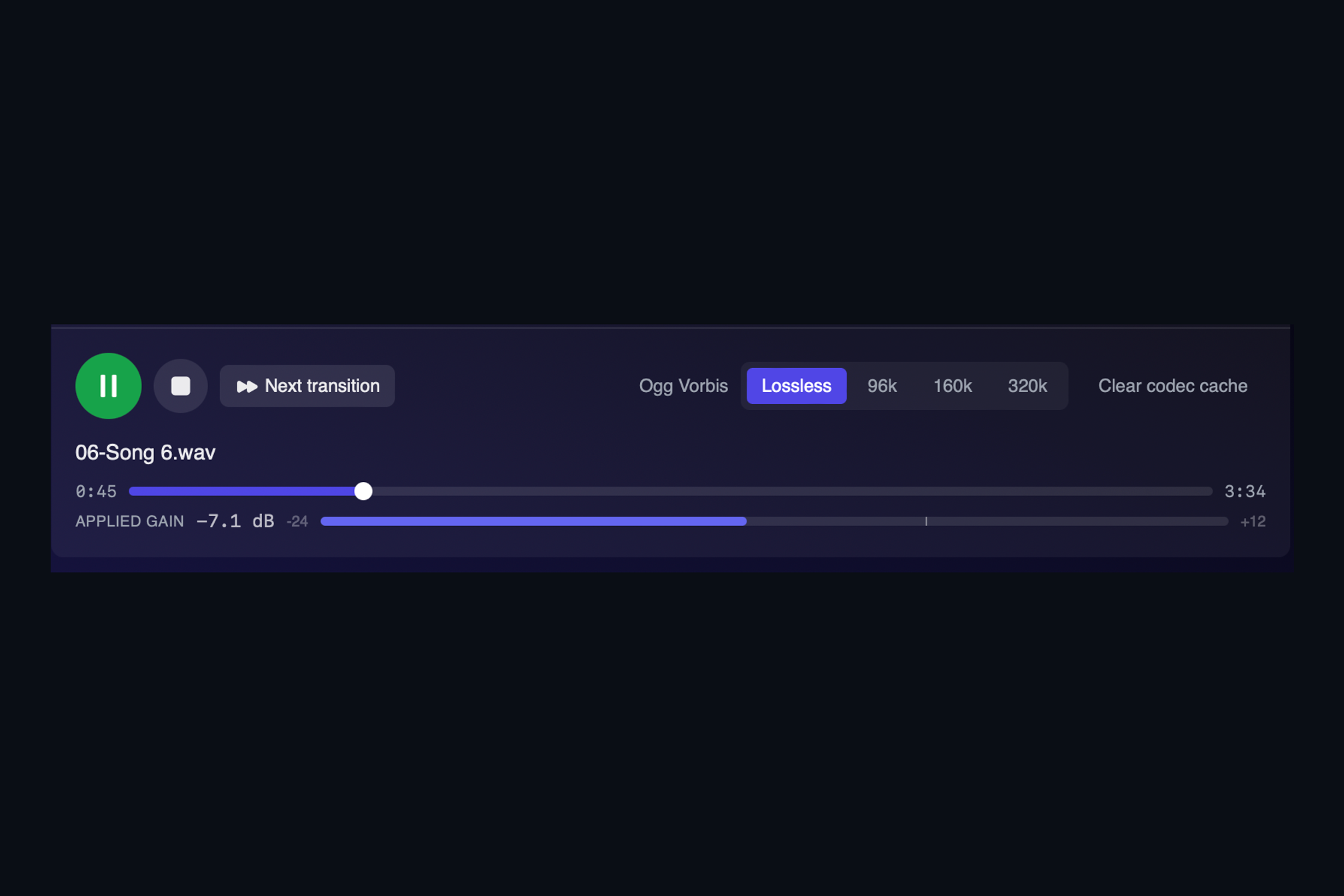
Injector lets you listen the way the subscriber will. Choose a platform, and the transport offers that platform's codec and bitrates alongside Lossless:
- Spotify previews through Ogg Vorbis at 96, 160 or 320 kbps.
- Apple Music and Amazon Music preview through AAC at 256 kbps, encoded with Apple's own system encoder.
- YouTube and SoundCloud preview through Opus at their respective bitrates.
- TIDAL streams lossless, so its preview is your master at TIDAL's level.
The encoded version is played at the gain the platform would apply, so you are hearing both effects together: the codec and the normalization. Click Lossless and the same track plays untouched, at the same position. That is the A/B that matters.
What to listen for
A cymbal wash that turns to a swirl, a reverb tail that fizzes, a vocal sibilant that smears: these are the moments where a small change to the master, a touch less top, a little less width in the highs, makes the streaming version noticeably better. Hearing it before release is the difference between fixing it and reading about it in a comment.
Encoded previews are kept in a cache, so switching between settings is instant after the first play.
Keep reading
This post is part of a series that walks through everything AMIE does. See the whole list on the AMIE product page, or see plans and pricing.
- Next in the series: Compare all platforms in one table
- Previous: Injector: how loud your master will really play on each platform