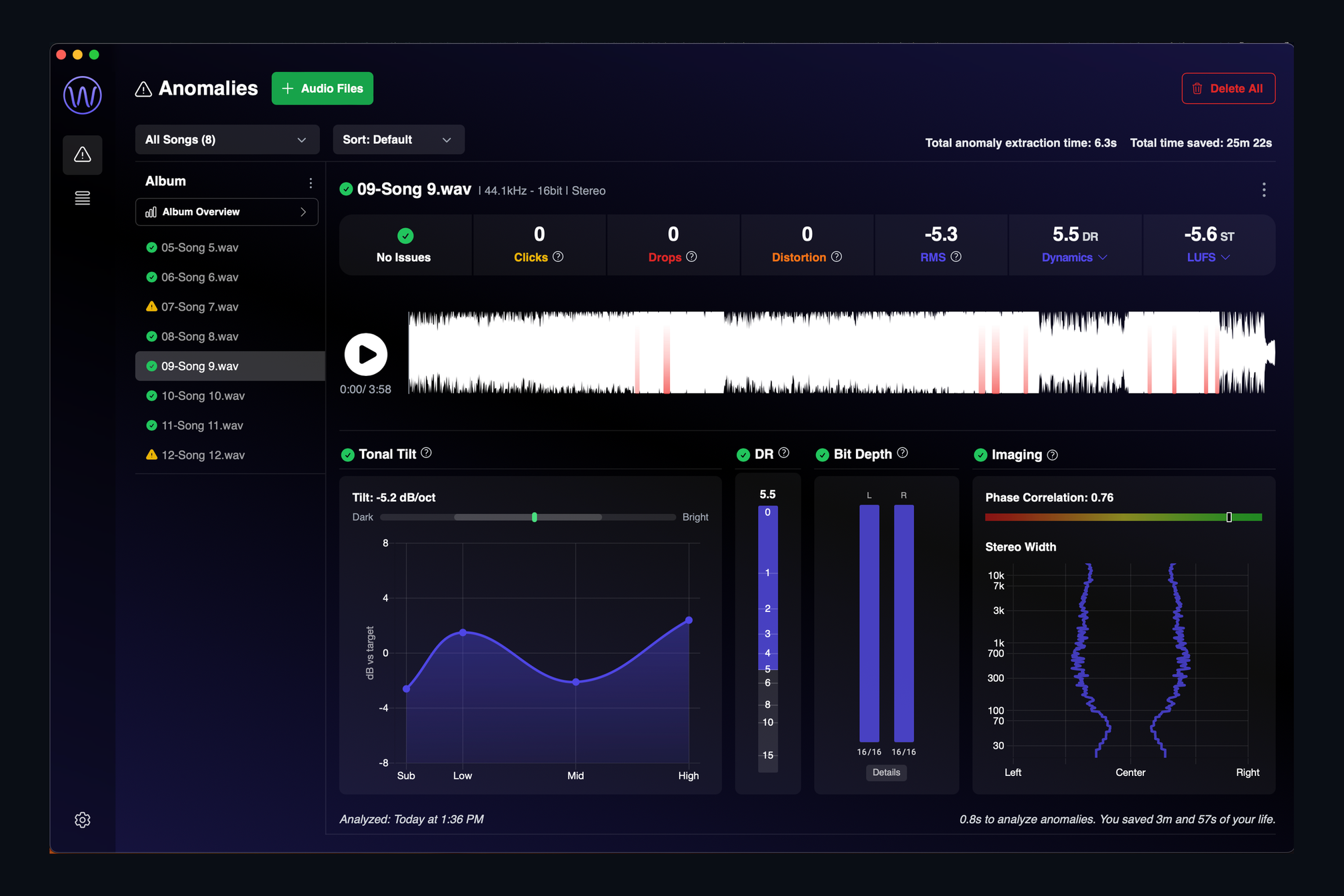
Immersive mixes arrive as one large file, an ADM Broadcast Wave, that can carry a bed of up to a dozen or more speaker channels and dozens of objects on top. A click buried in a single height channel is still a click, and a stereo fold-down will hide it. AMIE opens the file as it is.
When you load an Atmos master, AMIE reads the embedded channel map and shows a chip with the bed layout and the number of objects. It then runs the detectors that depend on the raw signal on every channel separately: clicks and pops, flat-top distortion, and true peak. A problem in the right rear surround is reported as a problem in the right rear surround, with its own numbers.
What is measured where
- Per channel: clicks, distortion and true peak, on every bed channel and every object.
- On a stereo fold-down: loudness, dynamics, drops and stereo imaging. These are reported as approximate, and the banner on the song says so.
The fold-down follows the usual broadcast mixdown rules, with objects placed where they start and the LFE left out, so the loudness reading is a sensible guide to how the music will sit against a stereo release. It is not a substitute for a certified Atmos loudness measurement on the renderer, and AMIE does not claim it is.
Playback is not available for Atmos files inside AMIE. The job here is the one that takes longest by hand: making sure none of the channels in a very large file is carrying a defect you would never find by listening to the stereo print.
Keep reading
This post is part of a series that walks through everything AMIE does. See the whole list on the AMIE product page, or see plans and pricing.
- Next in the series: One-click De-click, re-verified after the repair
- Previous: Album overview: every track of a release, side by side