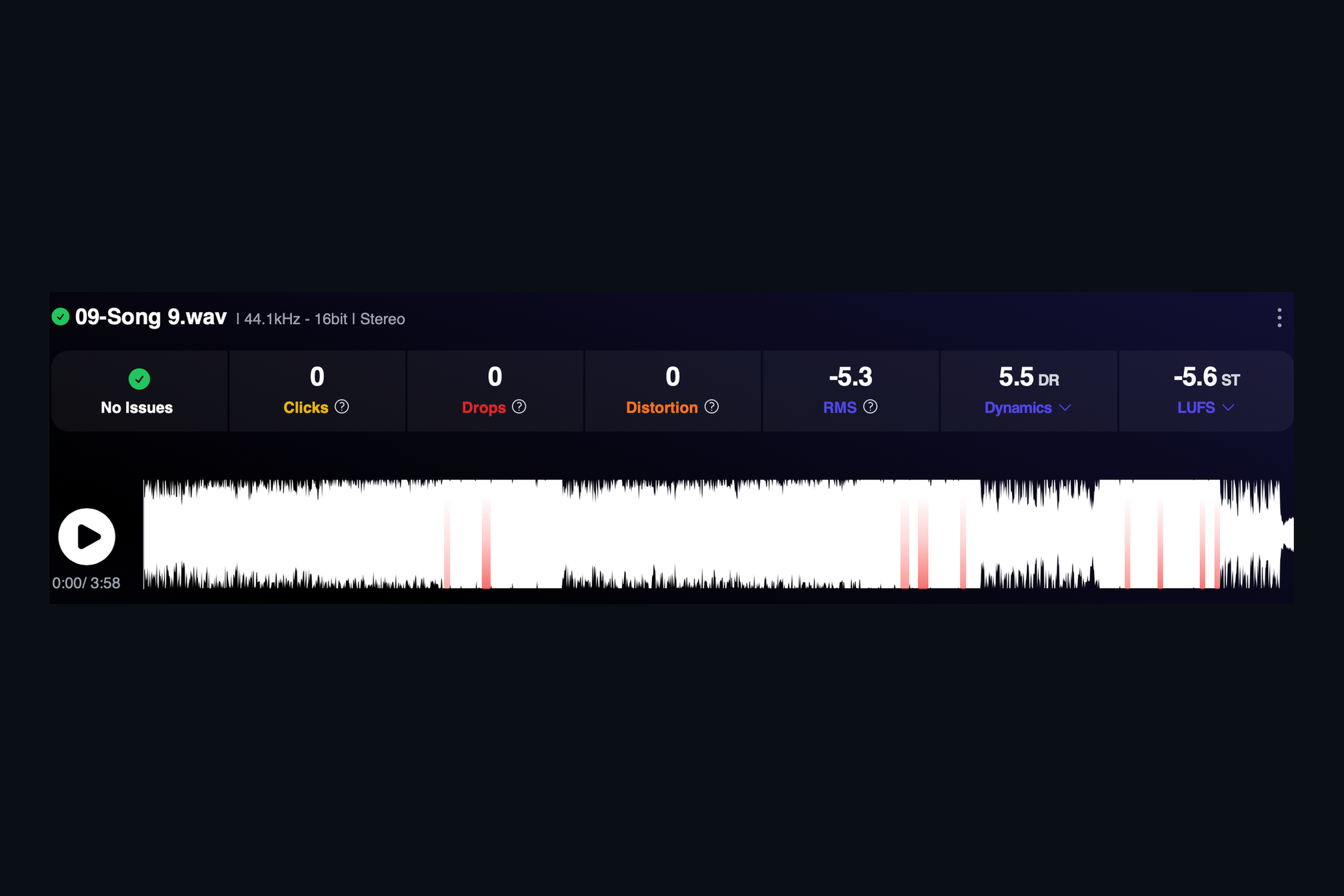
Loudness used to be a matter of taste. Now it is a matter of arithmetic, because every streaming platform measures your master and adjusts it to a target before anyone hears it. If you know your numbers before you upload, there are no surprises on release day.
AMIE measures three of them for every file it analyzes.
Integrated loudness
This is the average loudness of the whole song in LUFS, using the same international standard the platforms use, so the number you see in AMIE is the number they will see. AMIE also keeps the short-term and momentary readings, so you can see how a chorus sits against the verses.
True peak
A sample peak meter only looks at the dots. True peak looks at the waveform between the dots, which is what a converter or a lossy encoder actually reproduces. A master that reads just under full scale on a sample meter can still overshoot on playback, and that overshoot is what platforms penalize and what causes crackle on cheap players. AMIE measures true peak with the oversampled method defined in the loudness standard.
Dynamic range
The dynamics reading tells you how much life is left between the loudest moments and the average level. AMIE warns when a master is squeezed so hard that the number falls below a sensible floor, and it also points out the opposite case, content so dynamic that it may be hard to hear on a phone.
All three sit in the stats row of every song, with a dropdown to switch between integrated, short-term and momentary loudness, or between dynamic range and loudness range.
Keep reading
This post is part of a series that walks through everything AMIE does. See the whole list on the AMIE product page, or see plans and pricing.
- Next in the series: Tonal tilt and stereo imaging
- Previous: Clicks, pops, drops and distortion, flagged in seconds